Convair Model 60 — The Twin-Jet That Could Have Rivaled the Boeing 737-200
Overview
The Convair Model 60 was a proposed twin-engine narrow-body jet airliner, developed internally during the late Convair / early General Dynamics era. Intended as a smaller, more economical derivative of the Convair 880, the Model 60 represents a rare “what-if” scenario:
a Convair competitor to the Boeing 737-200 — if Convair had survived the jet airliner market.
.png)
Unlike mainstream designs, documentation of the Model 60 is extremely scarce. Most surviving references come from archived three-view drawings and niche aviation research communities. This makes the aircraft both historically obscure and technically fascinating.
.png)
Historical Context
Convair’s commercial jet lineage includes:
- Convair 880 — high-speed, medium-range jet
- Convair 990 Coronado — faster but commercially unsuccessful
By the late 1960s, market pressure from Boeing and Douglas forced Convair to explore lower-cost, smaller-capacity jets. The Model 60 was conceived as:
- A shorter, lighter Convair 880 derivative
- A twin-engine alternative to reduce fuel burn and maintenance costs
- A direct response to the emerging 737-200 market
.png)
However, Convair’s exit from commercial aviation prevented the aircraft from reaching prototype or production.
.png)
Airframe & Configuration
Fuselage
- Based on Convair 880 cross-section
- Shortened to ~87.5% of Convair 880 length
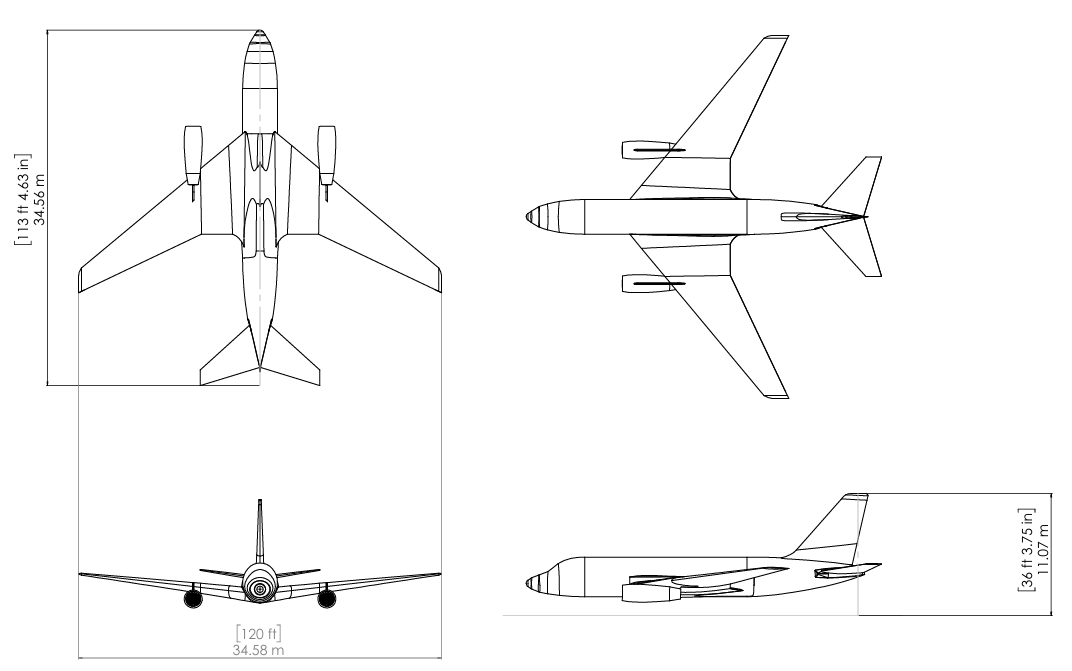
- Approximate total length: ~34 m (111.5 ft)
(Convair 880 baseline ≈ 39 m / 128 ft)
.png)
Cabin Layout
- Retains 5-abreast seating (2+3) — same as Convair 880
- Assumed seat pitch: 33 in (0.838 m)
.png)
Estimated Passenger Capacity Impact
With ~5 m (16.4 ft) removed from fuselage length:
| Parameter | Estimate |
|---|---|
| Rows removed | ~6–8 rows |
| Seats per row | 5 |
| Seat reduction | ~30–40 passengers |
.png)
Estimated passenger capacity:
~90–110 passengers (depending on galley/lavatory layout)
This places it squarely in 737-200 class capacity.
.png)
Wing & Aerodynamics
The Model 60 retains the Convair 880M wing and wingbox, preserving high-speed cruise efficiency.
Wing Profile
- Root airfoil: NACA 64-0012
- Tip airfoil: NACA 64-0008
- Span: 36.58 m (120.0 ft)
.png)
Implications
- Same high cruise Mach potential as the 880M
- Likely cruise speed comparable to Convair 880:
- ~Mach 0.82–0.84
- Faster than early 737 variants
This makes the Model 60 a speed-optimized narrow-body, unlike most short-haul competitors.
Engine Concept — CJ805 Turbofan Lineage
A defining feature of the Model 60 is its proposed use of the CJ805 turbofan family, originally developed for the Convair 990.
Candidate Engines
| Engine | Thrust | Notes |
|---|---|---|
| CJ805-23B | ~71 kN (16,000 lbf) | Real production variant |
| CJ805-41C (speculative) | Higher thrust ~74.73 kN (16,800 lbf) | Improved efficiency concept |
.png)
The CJ805-41C can be interpreted as a fictional or projected improved turbofan, offering:
- Better thrust-to-weight ratio
- Lower fuel consumption than early CJ805 variants
- Improved takeoff and climb performance
.png)
Mass & Thrust-to-Weight Ratio
Assumed Maximum Takeoff Weight (MTOW)
- ≈ 60,312.6 kg
- ≈ 132,964 lb
Thrust-to-Weight Ratio (T/W)
Assuming 2 × 71 kN engines:
| Parameter | Value |
|---|---|
| Total thrust | 142 kN |
| MTOW | 60.3 t |
| T/W ratio | ~0.24 |
This is:
- Competitive with early narrow-body jets
- Adequate for short-to-medium runway performance
- Strong for a high-speed wing platform
.png)
Fuel Capacity & Range Trade-Offs
Because the Model 60:
- Retains the 880 wing
- Uses a shorter fuselage
- Likely carries less fuel
Expected consequences:
- Reduced maximum range
- Optimized for regional / medium-haul routes
- Potential sweet spot: 2,000–3,500 km (1,080–1,890 nmi)
Engineering Uniqueness
1. High-Speed Narrow-Body Philosophy
Unlike 737-class aircraft optimized for economy, the Model 60 prioritizes:
- Speed
- Wing efficiency
- Convair’s “fast airliner” DNA
2. Wide 5-Abreast Cabin
- More comfortable than 4-abreast designs
- Better passenger comfort per row density
3. Rare Twin-Jet Convair Layout
Convair historically favored quad-jets — the Model 60 marks a shift toward modern twin-engine economics.
4. CJ805 Turbofan Evolution
A transitional step between:
- Early turbojets
- Later high-bypass turbofans
.png)
Operational Challenges If It Had Flown
Fuel Efficiency
CJ805 engines were noisy and less efficient compared to later turbofans.
Noise Compliance
Would likely struggle with modern ICAO noise regulations.
Maintenance Complexity
- Legacy Convair systems
- Limited parts ecosystem
Market Competition
Would have faced:
- Boeing 737-200
- Douglas DC-9
- Later Airbus A320 derivatives
Convair’s weak airline sales network would also limit adoption.
Why CAD Modeling the Convair Model 60 in 2026 Matters
1. Preserving Lost Aerospace History
This aircraft never entered production — CAD may become the most complete technical record ever made.
2. Engineering Forensics
Reconstructing:
- Structural feasibility
- CG behavior
- Wing-body interaction
- Performance envelopes
3. Educational Value
A rare case study in:
- Market failure
- Alternative airliner evolution
- Design paths Boeing didn’t take
4. Relevance to Modern Retro-Aero Concepts
Lessons applicable to:
- Sustainable aviation
- Efficient narrow-body revival
- Hybrid electric regional aircraft
5. Fifty Years Later — We Can Finally Simulate It Properly
Modern CFD, CAD, and digital twins allow analysis Convair engineers never had.
Summary — A Jet That Almost Existed
The Convair Model 60 represents a parallel aviation timeline:
A fast, twin-engine, 737-class jet built on Convair 880-era high-speed aerodynamics.
It may never have flown —
but in 2026, with CAD, CFD, and engineering reconstruction,
we can finally test what Convair never got to build.