Tupolev Tu-134
A Short-Haul Jetliner and an Evolving Soviet Design Lineage The Tupolev Tu-134 was a foundational short-haul jetliner in Soviet and post-Soviet aviation. Developed from earlier Tupolev designs, it evolved continuously over decades, adapting to changing navigation practices, operational doctrines, and later, modernization concepts.
This repository documents the Tu-134 family as reconstructed in CAD, following a variant structure aligned with design evolution rather than official marketing designations. Each variant represents a distinct configuration state with meaningful structural, aerodynamic, or systems-level differences. Aircraft Family Overview (Repository Variant Logic)
The Tu-134 family in this project is organized as follows:
- Tu-124A (Tu-134 Prototype) – Development aircraft bridging Tu-124 and Tu-134 concepts
- Tu-134A-5 (Early Production) – Initial service configuration with full navigator glazing
- Tu-134A-2 (Modified) – Late navigator variant with compromised blister and refined nose
- Tu-134B-3 (Final) – Final production standard with redesigned nose and reduced crew
- Tu-134M (Proposal) – Post-Soviet stretched and modernized concept with PS-90 engines
- Tu-134UBL (Military) – Specialized RuAF / VVS / VKS training and operational variant
Each variant is documented on its own subpage, preserving configuration-specific geometry and design intent.
Variant Subpages
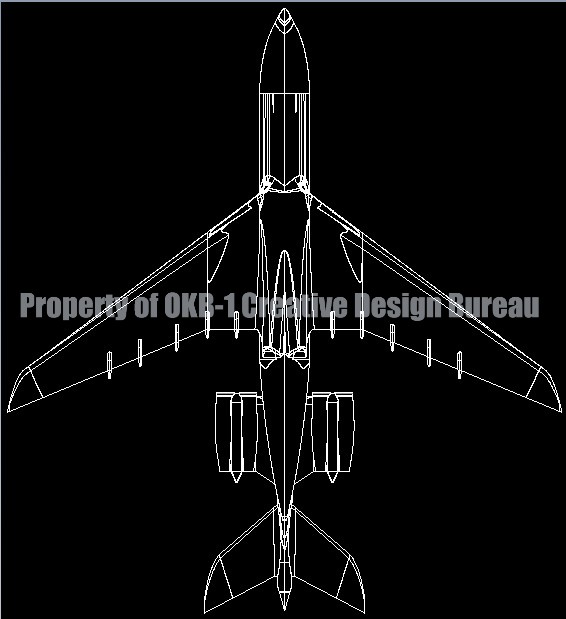
[Return to Main Tu-134 Article]((https://okb1creativedesignbureau-spec.github.io/OKB-1_Creative_Design_Bureau/products/Tu-134)
Pack A — 3D Printing Pack (STL + 3MF Only)
Get Tu-134 All Series Bundle 3D Printing Pack Here for €40
Includes:
- High-resolution STL of the aircraft
- Included Custom Aircraft Stands
- Clean watertight mesh suitable for resin or FDM printing
- 3MF file for layout reference
- Aerodynamic, smooth loft surfaces just like wind tunnel models
- Ready for slicing (Cura, PrusaSlicer, Bambu Studio, Orca-Slicer)
- Optional: scaled versions (1:150, but can be re-sized as 1:72, 1:144, 1:48, etc.)
Perfect for: Collectors · Modelers · 3D printer hobbyists
Pack B — RC Maker Pack (DXF + 3MF)
Get Tu-134 All Series Bundle RC Maker Pack Here for €60
Includes:
- Full DXF cross-section slices (wing + fuselage) for laser cutting
- Up to ~50 fuselage stations
- Wing rib sections
- Clean orthographic section cuts
- 3MF file for RC layout reference
Perfect for: RC aircraft builders · Laser-cut foam/balsa makers · Workshops
Pack C — Engineering Pack (CAD Only)
Get Tu-134 All Series Bundle Engineering CAD Pack Here for €80
Includes:
- Full STEP 214 file (solid bodies + surfaces)
- Full IGES file (solid bodies + surfaces)
- Full CATIA file (solid bodies + surfaces)
Complete aircraft with precise NURBS lofts Suitable for:
- SolidWorks
- Fusion 360
- CATIA
- Creo
- Siemens NX
Engineering-grade geometry
- Perfect for editing, CFD pre-processing, and derivative design work
- 3MF file for layout reference included
Perfect for: Engineers · Students · Aerospace researchers
Pack D — Merchandise Art Pack (DXF + DWG + PDF)
Get Tu-134 All Series Bundle Merchandise Art Pack Here for €30
Includes:
Clean line-art views:
- 3-side view (top, side, front) + Bonus 1-side view (belly)
- Isometric view
- Provided in DXF + DWG + PDF
PDF in both modern black-over-white diagram as well as negative-white-over-black diagram High resolution, ready for:
- T-shirt designs
- Posters
- Stickers
- Wallpapers
- Classroom material
Perfect for: Artists · Merch stores · Classroom projects · Aviation fans
Pack E — Blender Artist Pack (OBJ + STEP + 3MF + GLB + GLTF)
Get Tu-134 All Series Bundle Blender Artist Pack Here for €35
Includes:
- OBJ + GLB file exported from CAD
- Ultra-smooth wind-tunnel-grade geometry
- STEP file included for those who want to re-export their own mesh
Ready to import into:
- Blender
- Cinema 4D
- Maya
- ZBrush
- 3MF file for layout reference included
Note: Untextured, raw CAD mesh. Perfect for sculpting, kitbashing, rendering, or custom livery painting.
Perfect for: Blender users · Render artists · Hard-surface kitbashers
All Series Ultimate Pack
Includes EVERYTHING in Packs A–E
- STL + 3MF 3D Print model
- DXF Cross Section Laser Cut RC
- STEP 214 + IGES + CGR Engineering model
- DXF + PDF + DWG Merch Poster
- OBJ + STEP + 3MF + GLB + GLTF Render Artist
What You Can Do With These Packs
Depending on the pack you choose, you can:
- 3D print the aircraft
- Build RC laser-cut models
- Perform CAD or CFD analysis
- Render it in Blender
- Create posters, stickers, and merch
- Study the engineering form
This product line is divided into clear “factory-floor” production tiers for different users: 3D printers, CAD engineers, RC builders, artists, and hobbyists.
Tu-124A (Tu-134 Prototype)
The Tu-124A represents the transitional prototype stage leading directly to the Tu-134. While visually similar to later aircraft, it retains structural and aerodynamic characteristics rooted in the Tu-124 lineage.
Key Characteristics
- Early fuselage proportions and structural layout
- Initial rear-engine integration
- Prototype wing geometry and incidence
- Development-focused systems arrangement
- Configuration used to validate the Tu-134 concept
CAD Notes
This model preserves early geometry that was later refined, particularly around wing-root blending, engine mounting, and fuselage contour continuity.
The Tu-124A is critical for understanding how the Tu-134 diverged from its predecessor while retaining key architectural elements.
Tu-134A-5 (Early Production Variant)
The Tu-134A5 represents the first mature production configuration entering widespread service.
Design Features
- Fully glazed navigator’s nose
- Production-standard fuselage length
- Early-series engine nacelles
- Traditional multi-crew cockpit arrangement
- Structural robustness tailored for regional operations
Operational Context
This variant reflects operational realities of early Soviet jet transport, where independent navigation capability and crew redundancy were prioritized.
CAD Fidelity
- Accurate navigator glazing geometry
- Production fuselage lofts
- Correct early nacelle profiles
- Solid, parametric geometry throughout
Tu-134A-2 (Modified)
(Late Navigator Variant) The Tu-134A2 (modified) represents a late-stage compromise configuration, retaining a navigator’s position while reducing the size and prominence of the nose blister.
Engineering Changes
- Compromised / reduced navigator glazing
- Refined nose profile for improved aerodynamics
- Transitional cockpit philosophy -Structural continuity with earlier A-series airframes
Significance
This variant illustrates the gradual shift away from classical navigation practices without a complete redesign of the airframe.
CAD Reconstruction Focus
- Hybrid nose geometry unique to this configuration
- Precise modeling of blister reduction
- Variant-specific fuselage forward-section lofting
Tu-134B-3 (Final Production Standard)
The Tu-134B3 represents the final and most refined production form of the Tu-134.
Key Characteristics
- Fully redesigned nose with no navigator glazing
- Reduced flight crew
- Improved aerodynamics and visibility
- Mature systems and avionics integration
- Peak operational efficiency of the series
Design Maturity
This variant marks the Tu-134’s transition toward internationally familiar cockpit standards while maintaining its characteristic structural design.
CAD Precision
- Clean nose loft without glazing artifacts
- Final fuselage configuration
- Mature wing and tail integration
- Fully parametric solid model
Tu-134M (What-If Post-Soviet Modernization)
The Tu-134M is a conceptual, never-built modernization exploring how the Tu-134 might have evolved in the post-Soviet era.
Conceptual Changes
- Stretched fuselage for increased capacity
- Modernized cockpit and systems philosophy
- Replacement of original engines with PS-90 turbofans
- Improved fuel efficiency and noise compliance
- Retention of Tu-134 family aerodynamic identity
Design Philosophy
This variant applies modern engineering logic to a legacy airframe, balancing realism with creative extrapolation.
CAD Approach
- Consistent structural logic applied to stretch
- Engine integration based on real PS-90 geometry
- Aerodynamic continuity preserved across surfaces
Tu-134UBL (RuAF / VVS / VKS Special Variant)
The Tu-134UBL is a specialized military variant developed for the Russian Air Force and later VKS.
Role and Purpose
- Crew training and specialized operational tasks
- Modified nose profile distinct from civil variants
- Military-specific systems and equipment
- Long service life well beyond civil retirement
Engineering Significance
The UBL demonstrates the Tu-134’s adaptability beyond civil transport, serving in roles far removed from its original airline mission.
CAD Reconstruction Focus
- Variant-unique nose geometry
- Military external configuration details
- Structural differences from civil B-series aircraft
Why the Tu-134 Matters
The Tu-134 remains significant because it:
- Defined Soviet short-haul jet transport for decades
- Demonstrated gradual, evolutionary aircraft development
- Bridged classical navigation practices and modern avionics
- Served both civil and military roles extensively
- Preserving these variants in CAD form allows direct study of how design philosophy, operational needs, and technology interacted over time.
Repository Intent
This project is intended for:
- Aerospace engineers and students
- CAD and geometry specialists
- Aviation historians
- Modelers and fabrication workflows
The emphasis is on engineering geometry, configuration evolution, and design intent.
Design Philosophy
Across all variants, the Tu-134 reflects several consistent Soviet design priorities:
- Robust operation from short or semi-prepared runways -Rear-mounted engines to reduce FOD and simplify ground operations
- Structural simplicity and maintainability
- Accommodation for independent navigation capabilities
- Long-term adaptability through incremental redesign -Unlike many Western counterparts, the Tu-134’s evolution was gradual, resulting in overlapping configurations rather than sharp generational breaks.
CAD Reconstruction Approach
- All variants in this repository are modeled as engineering-grade CAD, not visualization meshes.
- Fully lofted NURBS surfaces
- Solid fuselage, wing, nacelle, and empennage geometry
- Parametric construction enabling variant comparison
- Historically and logically consistent geometry changes
- Cross-sections exportable to DXF / DWG
Each variant is treated as a distinct airframe state, even where official naming conventions overlap.
See Also Different Aircraft of the Era
See Also Different Aircraft of the Era
Also Available Other Packs and Variants of the Tupolev Tu-134
Premium Bundle: